|
| |
| |
| |
| | |
ISSUE NO. 04 · AUGUST 2026 |
| | | |
| | | |
| | |
WELCOME BACK!
I have news, and I don’t want to bury it! The launch date has moved up. Self-Awareness and Trust will publish at the end of this month (August) instead of September 22. I do not have the exact date yet. Stay tuned, because you will be among the first to know when I do. I was hoping to have the book out for the Women in Medicine Summit - now I will also have it for the Mission Belonging Day of Belonging, and I couldn’t be more thrilled.
The past two weeks have been exciting in many ways. In addition to the book news, three podcast episodes went live, each with a team that gave me more than I expected. Great interviewers ask questions you have not fully answered for yourself yet, and all of them definitely did this. I found myself saying things out loud that I had only written down before. I am grateful for every person behind those three shows (see Connect with Jess section). They gave me their time and their preparation, and in more than one case, their own stories in exchange for mine.
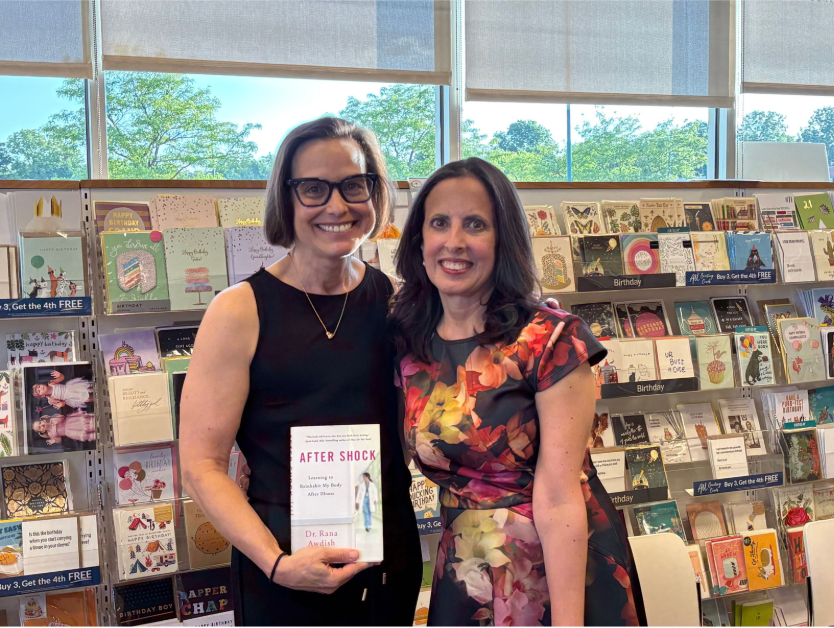
I had the opportunity to attend a reading and book signing for Rana Awdish’s new book, After Shock and finally meet her in person!! If you haven’t read it, you should! |
| | | |
| | | |
| | | |
| | |
FROM THE BOOK
SELF-AWARENESS AND TRUST: LEADING HEALTHCARE TEAMS FROM THE INSIDE OUT
CHAPTER 3: Self-Compassion, Boundaries, and the Myth of Medical Martyrdom
Chapter 2 was about the pause. Chapter 3 is about what happens when you run out of pauses to take, because you have spent every one of them proving you belong.
It opens upon my return to residency after nearly a year away from training for treatment for Hodgkin’s disease. I wanted to prove I still deserved my place, so I stayed late. I stayed to read one more textbook, help one more intern, rewrite one more note until it was perfect. I told myself it was commitment. Medicine rewards endurance, and I had learned to read that reward as love. At home, a relationship I mistook for partnership was quietly closing every door I had left open, and I told myself that too was sacrifice.
I could not set limits at work because patients needed me. I could not set limits at home because I believed love meant enduring without complaint. So I stopped complaining, and worse, I stopped noticing I had stopped. I was not sleeping. I was barely eating. I had started doing a kind of math in my head that I still find hard to write down, math about how many days I could disappear before anyone would notice.
I did not call it depression. I called it commitment, right up until the day Carmen pointed out, in a way that did not leave room for deflection, that I was not okay. She refused to accept "I'm just tired" as an answer. She named what she saw. She reminded me that I was not alone, and that I was not trapped. She offered herself and her home. Then she asked me one question I could not answer: "When was the last time you did something because you wanted to, not because someone needed you to?"
I felt seen, and I felt terrified, at exactly the same moment. Being known that precisely is not relief. It is exposure.
The chapter builds from that moment into a topic that I hope physicians will internalize. Boundaries are not walls. They are the line where I end and someone else begins, and without that line, there is no self left to bring to the people who need me, whether that is a patient or my own family. I break it into two kinds. Personal boundaries, which govern what I will absorb. Organizational boundaries, which govern what a system will normalize. The first protects the clinician. The second protects the profession, and I have come to believe that leaders are responsible for both.
I hope you will read Chapter 3 in a few weeks, and I hope it gives you permission to ask someone in your life the same question Carmen asked me. |
| | | |
| | | |
| | | |
| | |
A LEADER I AM WATCHING: Dr. Greg Argyros
Some leaders teach you something. A few save you. Greg Argyros has done both, at two different points in my life, years apart.
The first time was when I had Hodgkin’s disease. I was a resident then, which meant I was used to being useful, not being cared for. Greg did not treat me like a diagnosis or a colleague working through a personnel problem. He treated me like a full human being who happened to be sick and happened to also be training in his program. I do not know how many physicians can hold both of those truths about a person at once without letting one crowd out the other. He could. I have never forgotten what that felt like from the other side of the bed.
The second time was years later, at an American College of Physicians conference. By then I was serving as a Psychiatrist at West Point, and I ran into Greg between sessions. He looked at me and said, without hesitating, that I needed to get back to a teaching hospital and back to internal medicine, because I was a phenomenal teacher. I did not know that about myself until he said it. I am not sure I would have believed it from anyone else. Sometimes the truest thing someone can tell you is the thing you cannot see about yourself, and Greg has a way of seeing it and simply saying it out loud.
He recently talked about this same instinct on the Return on Empathy podcast. Leaders spend time with young people, he said, not because they will all become doctors or nurses, but because they will become leaders in whatever they choose, and he wants them to have empathy no matter what. He went further than that. He said leaders bear real responsibility for calming things down in this country, simply by how they treat the people around them.
That is the same man who sat with me during Hodgkin’s disease and the same man who told me I was a teacher before I knew it myself. Greg does not just talk about empathy. He has practiced it on me more times than I can count. I can’t imagine how many others he has touched. That is what makes him a leader worth watching. |
| | | |
| | | |
| | | |
| | |
CONNECT WITH JESS
Podcasts:
1. Stand up (for) Doctors: Empathy, Compassion, and Shame
2.Mindful Practice Podcast: LGBTQ+ Inclusion, Psychological Safety & Physician Leadership: Building Better Healthcare Systems
3. Sound Practice: Leading with Clarity: Self-Awareness, Civil Discourse, and the Future of Healthcare Culture with Dr. Jessica Bunin
Upcoming Events:
4. Triservice ACP: Aug 26-28, 2026; Bethesda, MD - Presenting: “Can leaders have a bad day?”
5. Mission Belonging, Day of Belonging: Sep 19, 2026, Rockwood Manor, Potomac, MD - Presenting: “The Ground We Stand On: Psychological Safety in Creative Communities”
6. WIM Summit: Sep 24–26, 2026, Chicago, IL, Presenting:
• “Leading Under Crisis” Panel Discussion Moderated by LTG (ret) Mark Hertling
• “Leading with Relational Precision: The Keystone between Authority and Influence”
• “She’s Too Much, She’s Not Enough: Gendered Communication and Feedback in Medicine”
7. StandUp4Doctors Retreat: Oct 9–12, 2026, Ossining, NY
8.American Association for Physician Leadership® (AAPL), Oct 22-24, 2026; Scottsdale, AZ - Presenting: “Across the Divide: A Practical Workshop in Civil Discourse.”
9. International Coaching Federation, Converge 2026, Oct 28-30, 2026, Washington, DC |
| | | |
| | | |
| | | |
| | |
| ONE QUESTION FOR REFLECTION
Who has been a life-saver in your life - in big ways or small? How might you thank them?
Please consider sharing the newsletter with someone who might like to join my journey. If you feel like reaching out, I would love to hear from you.
I will write again when I have more specifics on the book launch.
Warmly,
Jess |
| | | |
| | | |
|